In this article, we’ll explore: Assessment of perineal body properties in women with stress urinary incontinence using Transperineal shear wave elastography and why it matters today.
Related:
👉 "I feel more comfortable asking questions": How we worked with mosques to talk with Muslim women about reproductive health
👉 The Hidden Anchor: Understanding the Assessment of Perineal Body Properties in Women with Stress Urinary Incontinence Using Transperineal Shear Wave Elastography
👉 Why You Should Run and Get an IUD or Implant Now and Tell a Friend
We’ve all been there—or at least, many of us have. You’re at a friend’s birthday party, someone tells a hilarious joke, and as you start to laugh, you feel that familiar, dreaded “oops” moment. Or maybe it happens when you’re pushing yourself during a morning jog or simply lifting a heavy grocery bag. This isn’t just an embarrassing quirk; it’s a medical condition called Stress Urinary Incontinence (SUI), and it affects millions of women worldwide.
For a long time, the way we talked about “leaky bladders” was shrouded in a bit of mystery and a lot of hushed tones. Doctors would suggest Kegels, or perhaps surgery in severe cases, but the tools we had to actually see what was going wrong inside the pelvic floor were somewhat limited. That is, until now.
Today, we’re diving into a fascinating area of medical technology that sounds complicated but is actually quite revolutionary: the Assessment of perineal body properties in women with stress urinary incontinence using Transperineal shear wave elastography. Don’t let the long name scare you off. We’re going to break down exactly what this means, why it matters for your health, and how it’s helping women regain their confidence.
The Hidden Hero: What is the Perineal Body?
To understand why things go wrong, we first have to understand the anatomy. Imagine your pelvic floor as a complex, high-tension trampoline. It supports your bladder, your uterus, and your bowels. Right in the middle of this trampoline—the “central hub,” if you will—is a small but mighty structure called the perineal body.
The perineal body is a wedge-shaped mass of muscle and connective tissue located between the vaginal opening and the anus. Think of it as the “keystone” in a stone arch. If the keystone is strong and well-positioned, the whole arch stands firm. If the keystone is weak, scarred, or out of alignment, the entire structure becomes unstable. In the world of pelvic health, when the perineal body loses its integrity, it can lead to pelvic organ prolapse and, very commonly, stress urinary incontinence.
Why the Perineal Body Fails
Life happens. Pregnancy and childbirth are the most common reasons the perineal body might lose its “bounce.” During a vaginal delivery, this area undergoes immense stretching. Sometimes, there are tears or episiotomies that result in scar tissue. As we age, or as estrogen levels drop during menopause, the quality of this tissue can change, becoming either too thin or too stiff to do its job effectively.
Enter the Tech: What is Transperineal Shear Wave Elastography?
In the past, a doctor might assess your pelvic floor strength by performing a manual exam—basically, “feel and guess.” While experienced doctors are great at this, it’s subjective. One doctor might think your muscles feel “firm,” while another might think they feel “average.”
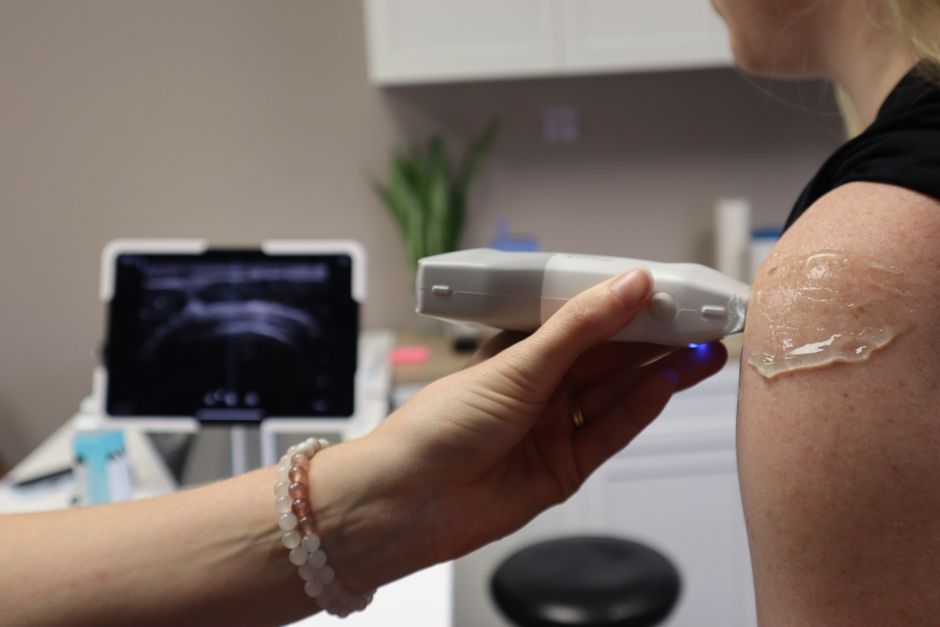
This is where Transperineal shear wave elastography (SWE) comes in. Imagine if you could take a “digital poke” at a tissue to see exactly how stiff or soft it is. That’s essentially what SWE does.
- Transperineal: This simply means the ultrasound probe is placed on the outside of the body, against the perineum (the area between the legs), rather than inside the vagina. It’s non-invasive and much more comfortable for the patient.
- Shear Wave: The machine sends out a specialized pulse that creates tiny “ripples” (shear waves) in the tissue.
- Elastography: The machine measures how fast those ripples travel. In stiff, hard tissue (like a scar), the ripples move fast. In soft, weak tissue, they move slowly.
By using this technology, doctors can get a color-coded map of the perineal body. It’s like a weather map for your pelvic floor—red might mean stiff, while blue means soft. This gives us a concrete, mathematical measurement of tissue health.
The Deep Dive: Assessment of Perineal Body Properties in Women with Stress Urinary Incontinence
So, why are researchers so focused on the Assessment of perineal body properties in women with stress urinary incontinence using Transperineal shear wave elastography? Because for the first time, we can see the “why” behind the symptoms.
Recent studies have shown that women with SUI often have significantly different perineal body properties than women who don’t have SUI. Here’s what the science is telling us:
1. The “Softness” Factor
In many women with SUI, the perineal body appears “softer” or less elastic on the SWE scan. This indicates that the connective tissue and muscle fibers aren’t providing enough tension to support the urethra when you cough or sneeze. If the “keystone” is soft, the “arch” of the pelvic floor collapses under pressure.
2. The Role of Scar Tissue
Conversely, some women have very “stiff” readings. This often points to fibrosis or scar tissue from previous births. While “stiff” might sound strong, scar tissue is actually brittle and doesn’t contract well. It lacks the dynamic flexibility needed to keep the bladder closed during physical activity.
3. Coordination Issues
SWE doesn’t just look at the tissue at rest. Doctors can use it to watch how the perineal body reacts when you perform a Kegel or a “Valsalva” maneuver (straining). In healthy women, the perineal body stiffens and moves in a specific way. In women with SUI, the timing is often off—the tissue doesn’t “brace” for impact quickly enough.
A Real-World Example: Sarah’s Story
Let’s look at a hypothetical patient named Sarah. Sarah is a 42-year-old mother of two who loves CrossFit. Over the last year, she noticed she had to wear a pad every time she did double-unders or heavy squats because of leakage. She tried doing Kegels at home, but they didn’t seem to help.
Sarah went to a specialist who performed an Assessment of perineal body properties in women with stress urinary incontinence using Transperineal shear wave elastography. The scan revealed that while her pelvic floor muscles were actually quite strong, her perineal body was unusually “soft” and lacked the structural stiffness to support her urethra during high-impact movements.
Because of this specific data, her physical therapist changed her routine. Instead of just “squeezing,” they focused on “loading” exercises that helped build up the collagen and tension in that specific central hub. Without the SWE scan, Sarah might have spent years doing the wrong exercises.
Why This Is a Game-Changer for Treatment
The move toward using Transperineal shear wave elastography isn’t just about cool gadgets; it’s about precision medicine. When we can accurately measure the properties of the perineal body, we can tailor treatments to the individual.
Personalized Physical Therapy
If the SWE shows the tissue is too stiff (scarred), the therapist might use manual release techniques. If it’s too soft, they might focus on high-intensity strengthening or even collagen-stimulating treatments.
Predicting Surgical Success
For women considering surgery (like a mid-urethral sling), knowing the state of the perineal body can help predict how well the surgery will work. If the surrounding tissue is too weak to hold a sling in place, the doctor might suggest other options first.
Monitoring Progress
One of the hardest parts of pelvic floor rehab is that you can’t “see” your muscles getting bigger like you can with your biceps. SWE allows patients to see their progress on a screen. Seeing the tissue properties improve over months of therapy is incredibly motivating.
Key Takeaways
- The Perineal Body is Essential: It acts as the central support beam for your entire pelvic floor.
- SWE is a “Digital Poke”: Transperineal shear wave elastography allows doctors to measure tissue stiffness objectively and non-invasively.
- SUI is Structural: Stress urinary incontinence isn’t just about “weak muscles”; it’s about the physical properties (elasticity and stiffness) of the supporting tissues.
- Better Data = Better Results: Using SWE leads to more accurate diagnoses and more effective, personalized treatment plans.
Frequently Asked Questions
Is Transperineal Shear Wave Elastography painful?
Not at all! It is just like a regular ultrasound. A probe is placed against the skin (with some warm gel), and you might feel a slight pressure, but there are no needles, no radiation, and no internal discomfort.
How long does the assessment take?
The actual scanning process usually takes between 10 and 20 minutes. It’s a quick addition to a standard pelvic health exam that provides a wealth of information.
Can this technology cure my incontinence?
The technology itself is a diagnostic tool, not a cure. However, it provides the “roadmap” your doctor or physical therapist needs to find the right cure for you. It takes the guesswork out of your recovery.
Who should ask for this test?
If you suffer from SUI and haven’t seen improvement with standard exercises, or if you are planning for pelvic surgery, you might ask your urologist or pelvic floor specialist if they use elastography to assess tissue quality.
Final Thoughts
Stress urinary incontinence can make your world feel smaller. It makes you hesitate to laugh, dance, or play with your kids. But with the Assessment of perineal body properties in women with stress urinary incontinence using Transperineal shear wave elastography, we are entering a new era of pelvic health. We are moving away from “one size fits all” advice and toward a future where we can see, measure, and treat the root cause of the problem.
If you’re struggling, know that the science is catching up to your needs. You don’t have to just “live with it.” There are tools available now that can help you understand your body better than ever before. Here’s to laughing, jumping, and living life—leak-free!
Written with love and assistance and refined for quality.
🔗 Related: I feel more comfortable asking questions:…
🔗 Related: Gloria Steinem Personification of the Womens…
🔗 Related: Union Health Ministry rolls out Delhi…