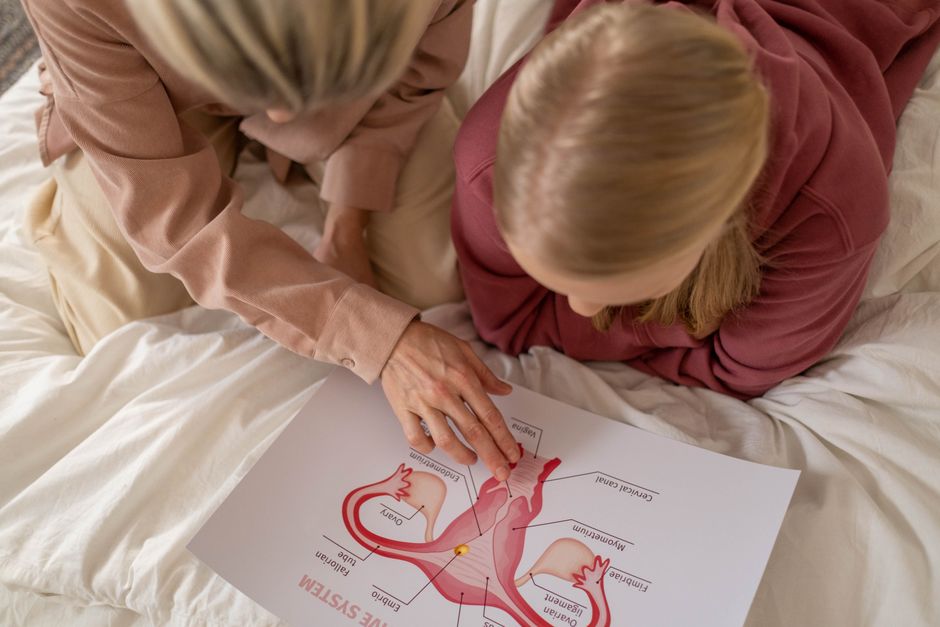
In this article, we’ll explore: For millions of women PCOS was never just about the ovaries and why it matters today.
Related:
👉 Period Poverty: A Global Menstrual Health Crisis We Can No Longer Ignore
👉 The Hidden Risk of the Weight Loss Revolution: A Perfect Storm for Bone Loss in Women (Menopause and GLP-1 Weight-Loss Drugs)
👉 Why Is It Harder to Get Pregnant with PCOS? Understanding the New Science of Uterine Receptivity
Learn more: For millions of women PCOS was never just about the ovaries on Wikipedia
Imagine walking into a doctor’s office because you’re exhausted, your skin is breaking out like you’re sixteen again, and you haven’t had a regular period in months. The doctor runs a few tests, looks at an ultrasound, and says, “You have Polycystic Ovary Syndrome. Just lose some weight and take this birth control pill.”
For millions of women, this scene is all too familiar. But there’s a massive problem with that diagnosis. The name itself suggests the problem starts and ends with the ovaries. It implies that if you just “fix” the cysts, everything else will fall into place. However, the reality is much more complex. For millions of women PCOS was never just about the ovaries; it is a full-body, metabolic, and endocrine roller coaster that affects everything from the hair on their heads to the way their bodies process sugar.
In this post, we’re going to peel back the layers of this misunderstood condition. We’ll look at why the name is misleading, how it affects your entire system, and why we need to start looking at PCOS through a much wider lens.
The Great Misnomer: Why the Name “PCOS” is Failing Women
Let’s start with the elephant in the room: the name. “Polycystic Ovary Syndrome” is arguably one of the most misleading labels in modern medicine. First of all, the “cysts” aren’t actually cysts. They are tiny, underdeveloped follicles—eggs that didn’t quite make it to ovulation because of a hormonal imbalance. You can have PCOS without having any “cysts” at all, and you can have cysts on your ovaries without having the syndrome.
Because the name focuses on the ovaries, many women—and even some healthcare providers—treat it as a “period problem.” But for millions of women PCOS was never just about the ovaries. It is an endocrine disorder. This means it’s a system-wide communication breakdown between your brain, your pancreas, your adrenal glands, and yes, your ovaries. When we focus only on the reproductive aspect, we miss the forest for the trees.
A Shift in Perspective
In recent years, many experts have advocated for a name change to something like “Metabolic Reproductive Syndrome.” Why? Because the current name leads to delayed diagnoses for women who don’t have “typical” ovarian symptoms but are struggling with the metabolic fallout of the condition.
The Metabolic Engine: It’s About Insulin, Not Just Estrogen
If the ovaries are the “symptom,” insulin resistance is often the “engine” driving the car. It is estimated that up to 70% of women with PCOS have some level of insulin resistance. This is where the body’s cells don’t respond well to insulin, leading the pancreas to pump out more and more of it.
High levels of insulin do two very specific, very frustrating things:
- They trigger the ovaries to produce testosterone: This is why women with PCOS often deal with “male-pattern” symptoms like hair growth on the chin or thinning hair on the scalp.
- They make weight loss incredibly difficult: High insulin tells the body to store fat, specifically around the midsection. This isn’t a lack of willpower; it’s biology.
When we say that for millions of women PCOS was never just about the ovaries, we are talking about this metabolic struggle. It’s about how your body turns food into energy. When that process is broken, it affects your mood, your energy levels, and your long-term risk for Type 2 diabetes and heart disease.
The Invisible Battle: Mental Health and Brain Fog
One of the most neglected aspects of PCOS is the mental health toll. If you’ve ever felt like you’re walking through a thick fog, or if you find yourself struggling with sudden waves of anxiety or depression, you aren’t alone. These aren’t just “mood swings”—they are often tied to the hormonal fluctuations inherent in the condition.
The Inflammation Connection
PCOS is often characterized by low-grade chronic inflammation. This isn’t the kind of inflammation you get when you stub your toe; it’s a systemic state where your immune system is slightly “on edge” all the time. Research has shown that this systemic inflammation can affect brain chemistry, leading to higher rates of anxiety and clinical depression among women with the syndrome.
The “PCOS Brain”
Many women report “brain fog”—a feeling of being disconnected or unable to focus. When your blood sugar is a roller coaster because of insulin resistance, your brain isn’t getting a steady supply of fuel. This leads to irritability and cognitive fatigue. Again, this proves that for millions of women PCOS was never just about the ovaries; it’s about how the entire neurological system functions.
Real-World Example: Sarah’s Story
Take Sarah, a 28-year-old marketing executive. Sarah didn’t care much about her irregular periods—she wasn’t trying to get pregnant, so she figured it wasn’t a big deal. But she was struggling with crushing fatigue. She would sleep ten hours and wake up feeling like she hadn’t slept at all. She had developed painful cystic acne along her jawline, and despite running three times a week, she was gaining weight.
Her first doctor told her to “come back when you want to have a baby.” This is the classic mistake. By focusing only on her fertility (the ovaries), the doctor ignored Sarah’s systemic inflammation and insulin resistance. It wasn’t until she saw a functional medicine practitioner who looked at her gut health, her cortisol levels, and her blood sugar that she started to feel better. For Sarah, and for millions of women PCOS was never just about the ovaries; it was about regaining her energy and her confidence.
The Skin and Hair Struggle: More Than Just Vanity
We live in a world that judges women harshly based on their appearance. For women with PCOS, the physical symptoms can feel like a betrayal by their own bodies. Hirsutism (excessive hair growth on the face, chest, or back) and androgenic alopecia (thinning hair on the head) are caused by elevated androgens, or “male” hormones.
These symptoms are often dismissed as “cosmetic issues,” but they have a profound impact on self-esteem and social identity.
- Hirsutism: Spending hours plucking, waxing, or shaving can lead to skin irritation and deep-seated shame.
- Acne: PCOS-related acne is often deep, painful, and resistant to standard over-the-counter treatments.
- Hair Loss: Watching your hair thin can feel like losing a part of your femininity.
When we acknowledge that for millions of women PCOS was never just about the ovaries, we validate the emotional pain of these physical symptoms. We recognize that these are signs of an internal hormonal imbalance that needs systemic treatment, not just a better concealer.
Key Takeaways: What You Need to Know
- PCOS is an endocrine disorder: It affects the entire hormonal system, not just the reproductive organs.
- Insulin is a major player: Managing blood sugar is often more important for symptom relief than focusing on the ovaries themselves.
- The name is misleading: You don’t need “cysts” to have PCOS, and the “cysts” are actually follicles.
- Mental health matters: Anxiety, depression, and brain fog are legitimate symptoms of the hormonal and inflammatory landscape of PCOS.
- Holistic care is essential: Treatment should include diet, stress management, sleep, and sometimes medication or supplements, rather than just the birth control pill.
Moving Forward: A Whole-Body Approach to Healing
If you have been diagnosed with PCOS, or suspect you have it, it is time to stop looking at your ovaries as the “bad guys.” They are simply responding to the environment your body is providing. To truly find balance, we have to look at the whole picture.
This means advocating for comprehensive blood work that includes fasting insulin, Vitamin D levels, thyroid panels, and inflammatory markers. It means finding a healthcare provider who understands that for millions of women PCOS was never just about the ovaries and is willing to work on a lifestyle plan that supports your metabolic health.
Healing from PCOS isn’t about a “quick fix” or a “magic pill.” It’s about understanding the unique language of your body. It’s about realizing that your skin, your mood, your energy, and your cycles are all connected. When you start treating the root causes—inflammation, insulin resistance, and stress—the symptoms often begin to quiet down on their own.
Frequently Asked Questions (FAQ)
1. Can I have PCOS if my periods are regular?
Yes. While irregular periods are a common symptom, some women have regular cycles but still struggle with other markers of PCOS, such as high androgen levels (acne/hair growth) or metabolic issues. This is why a full hormonal panel is so important.
2. Why did my doctor only suggest birth control?
Birth control is often used to “mask” the symptoms of PCOS by providing synthetic hormones that regulate the cycle and lower androgens. While it can be helpful for some, it doesn’t address the underlying insulin resistance or inflammation. Many women find that their symptoms return as soon as they stop taking the pill.
3. Is PCOS a “weight” disease?
Absolutely not. While weight gain is a common symptom due to insulin resistance, there is a significant population of women with “Lean PCOS.” These women are thin but still struggle with the same hormonal and metabolic imbalances. This further proves that for millions of women PCOS was never just about the ovaries or weight.
4. Can PCOS be cured?
There is currently no “cure” in the sense that it goes away forever, but it can absolutely be managed to the point where symptoms are non-existent. Through lifestyle changes, diet, and sometimes supplements or medication, many women live completely symptom-free lives.
5. Does PCOS affect my ability to get pregnant?
It can make it more challenging because of irregular ovulation, but PCOS is one of the most treatable causes of infertility. Many women with PCOS go on to have healthy pregnancies once they address the underlying hormonal imbalances.
In conclusion, it is time we change the conversation. For millions of women PCOS was never just about the ovaries—it’s a journey of understanding the body’s complex systems and learning how to bring them back into harmony. You are more than your diagnosis, and you deserve a healthcare approach that sees the whole you.
Written with love and assistance and refined for quality.
🔗 Related: Health Rounds: Glucosamine used for joint…